

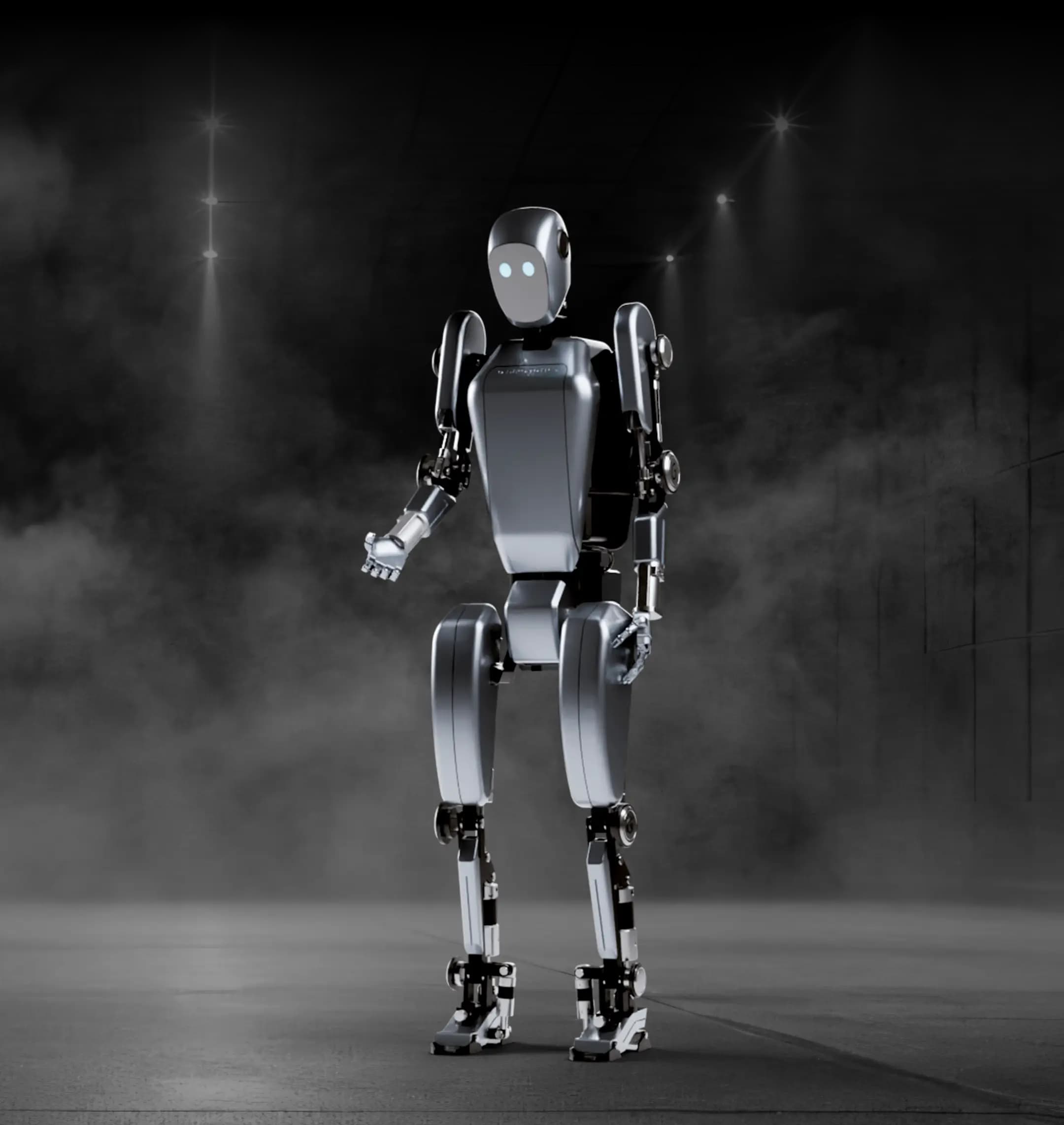
General Purpose Humanoid.

The Challenge & Vision
Building a true general-purpose humanoid requires solving the inherent complexities of bipedal locomotion, dynamic stability, and intuitive interaction in unstructured human environments. G Bot is our flagship project, aiming to create a highly dexterous and adaptable robot capable of seamlessly integrating into human workspaces and homes, revolutionizing service robotics.
Key R&D Breakthroughs:
- 1.Dynamic Balancing Algorithms: Real-time center-of-mass adjustment for stability on uneven ground and resistance to external forces.
- 2.Whole-Body Control (WBC): Coordinated movement of 40+ degrees of freedom for complex, human-like manipulation and movement.
- 3.General Purpose Gripper: Highly versatile end-effector designed to handle a wide range of objects, from delicate tools to heavy loads.
Applications and Versatility
G Bot is engineered to be a true generalist, designed to operate in complex spaces originally structured for human workers. Its bipedal form factor and advanced manipulation capabilities unlock opportunities in several high-value sectors
Industrial & Logistics
- Assembly line support and quality control.
- Warehouse material handling and shelf management.
- Operating standard human tools and machinery.
Domestic & Healthcare Support
- Assisted living support and mobility aid.
- Performing routine chores and fetching complex objects.
- Monitoring and basic intervention in non-critical situations.

Technical Specifications
Height
140 cm (Target)
Weight
40 kg (Target)
(Standard Payload)Degrees of Freedom
20
Max Speed
4 km/h
(Walking)Payload Capacity
5 kg
Power Source
Swappable Battery Packs
Development Roadmap
Our journey to a commercial-ready humanoid is segmented into rigorous phases, ensuring stability, safety, and performance at every stage.
Phase 1
Foundation & Locomotion (Completed)
Completed the full hardware design along with an end-to-end AI-driven control system.
Phase 2
Full-Scale Prototyping (Current)
Integrating whole-body control, basic object recognition, and testing dynamic stability on varied terrain.
Phase 3
Dexterity & Manipulation (Future)
Focus on complex multi-joint manipulation, advanced grasping techniques, and fine motor control.
Phase 4
Autonomous Task Execution (Future)
Deep integration of AI/ML for task planning, learning from demonstration, and natural human-robot interaction.